Showing posts with label iPhone. Show all posts

Monday, 24 January 2011

Newest Cydia release tracks, restores your jailbroken apps

Some say the best smartphone is a jailbroken iPhone, but one problem (aside from the obvious, that jailbreaking, although legal, voids your warranty) is the issue of reinstalling all your jailbreak-only apps if you update and re-jailbreak. The latest version of Cydia can help with that problem.

iTunes will restore your non-jailbroken apps when you upgrade to a new version of iOS, or if you restore your iPhone. For jailbroken apps, you have to re-install them manually, at least until now.

Cydia is the "market" that users go to for apps specifically for jailbroken iOS devices. Possibly because of technology Cydia acquired via Rock Your Phone, you can now login with your Facebook or Google account. Once that's done, Cydia will track your purchases, so that you can reapply them after you jailbreak the next version of iOS.

It's a lot better than having to hunt down your old apps again via the repositories involved. Of course, Apple would prefer not just that jailbreaking was harder, but that it couldn't be done. Considering it's the only way to get a useful lock screen (among other things), many hope otherwise.

Sunday, 23 January 2011

Two Promotional Apple iPhone - AT & T and Verizon

After months of fighting between Verizon, Apple and AT&T, the latest ad from Apple shows it's all one big happy family, showing the Verizon iPhone 4 and AT&T iPhone 4 side-by-side with the tagline "Two is Better Than One."

The ad is set to the Blue Danube (or An der schönen blauen Donau), the famous Johann Strauss waltz. It shows two iPhone 4s simultaneously scrolling, surfing, checking iBooks, using FaceTime, and more, all identically, before the AT&T and Verizon logos appear, followed by the tagline "Two is better than one."

Past ad campaigns by Verizon have mocked the AT&T network and the iPhone on it. Now that the popular smartphone is on the Verizon network, any anti-iPhone (and pro-Android) commercials will be a thing of the past.

One difference missing from the commercial, and one thing that Verizon iPhone buyers need to remember, is that voice and data calls cannot be made simultaneously on CDMA network. That means that if, say, you are listening to an Internet radio station, when a call comes in, the station feed will automatically terminate. Once the call ends, you will be reconnected.

Looking at it from the other direction, if you were on a call, you couldn't suddenly go to Yelp at the same time. In this case, you won't disconnect from the voice call; it just won't work.

Watch the video below.


Verizon's off-contract iPhone 4 price $50 more than AT&T


It's been said before that Verizon is the priciest U.S. carrier, and it certainly hasn't done anything to discount that belief with something just noticed in their FAQ. The unsubsidized, full retail price for the Verizon iPhone is $50 more than the same price for the AT&T iPhone.

Here's what the FAQ says re: Verizon iPhone 4 pricing:
$199.99 for the 16GB model, and $299.99 for the 32GB model, with a new 2 year agreement. iPhone 4 will also be available for purchase at full retail price - $649.99 for the 16GB model, and $749.99 for the 32GB model.
For the 16GB model, AT&T charges $599 and for the 32GB model,a $699.

It's unclear why Verizon is charging more for their version of the iPhone 4, but the most obvious thing that comes to mind is the CDMA chipset inside the device. While $50 compared to the full retail price of the device is small, it's still an interesting additional difference between the two iPhone 4s.

Apple retail stores seen carrying universal iPhone 4 bumpers

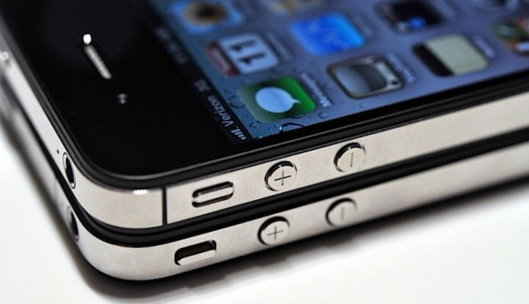
The Verizon iPhone isn't quite here yet, but a newly designed bumper case, that fits both the AT&T and Verizon versions, is. We noted earlier that some third-party cases, as well as Apple's own bumper cases, would need slight modifications to fit the new Verizon iPhone.

While the Verizon iPhone is mostly unchanged externally from the AT&T iPhone, there were some changes made to the metal band around the exterior, which functions as an antenna for the device. Because of this, the mute button was moved. The new bumper case has a wider opening for the mute switch, and that's the only change.

In addition to moving the mute switch slightly, the Verizon iPhone has 4 antenna gaps, while the AT&T design has only 3. Aside from that, it's pretty much the same device, except, Verizon would claim, that it runs on a more reliable network. Meanwhile, AT&T would claim it runs on a slower network.

For ourselves, speed doesn't count for much if the network is overloaded. The countdown to the Verizon iPhone 4 continues, with pre-orders beginning for existing Verizon customers on Feb. 3. You can see the unboxing video below.


Saturday, 22 January 2011

The App Store reaches the 10 billion download milestone

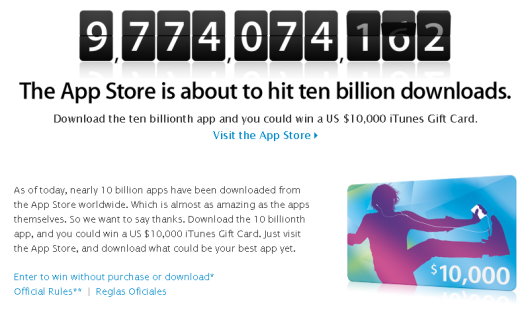
Apple thanked end users 10 billion times on Saturday, as the 10 billionth app from the App Store was downloaded. While we are not sure who the winner is yet (Apple says come back later), we know that the winner gets a $10,000 iTunes gift card.

The winner didn't actually have to download an app, either. There was a non-download entry form as well. The winner was either the downloader of the 10 billionth app, or the person who submitted an entry form immediately after the 9,999,999,999 app was downloaded.

The number of downloads in the App Store have been skyrocketing, along with device use. By the end of September 2009, the App Store was at 2 billion apps downloaded. About a year ago, in January 2010, there were 3 billion downloads. When the "countdown" began, the store was some 250M apps short, and that was just over a week ago.

In February of 2010, Apple had a different 10 billion download mark hit: the 10 billionth song song from iTunes: Johnny Cash's "Guess Things Happen That Way."

Update: The 10 billionth app downloaded was Paper Glider.  It was purchased by Gail Davis of Orpington, Kent, UK.  Davis will receive a $10,000 iTunes Gift Card.

AT&T's bottom 7.5 percent coverage-wise to get free Microcells

AT&T's 3G Microcell, along with other such devices for other carriers, is used to improve signal quality in areas with poor reception. Many believe that's the entire nation, but the company itself has been test marketing free Microcells in really bad areas, and its about to expand that program nationally.

Beginning on January 23, AT&T will be sending out mailers inviting customers determined to be qualified for the program to sign up for a free Microcell. AT&T has selected the "top 7.5 percent of 3G wireless customers identified as likely to experience poor in-building coverage at home or in small offices."

The catch is that you are committed to AT&T service for a year. If you exit before then you have to either return the MicroCell or pay the Microcell's upcoming new (and raised) price of $199.99 minus $16.67 for every month that you've had it.

This verbal agreement to keep the Microcell a year has no effect on your current service plans or your eligibility for an equipment upgrade.

A femtocell like AT&T's Microcell uses your home of office's broadband to give you a better signal. To the device, it's as though it's attached to a tower, but it's attached to the femtocell instead. For places with marginal coverage, it can be the only way to get a good signal.

In a way, this is a great deal for those who get it. In another way, it's not, as it tells you AT&T considers you in their worst 7.5 percent in terms of coverage.

Apple's latest attempt to 'screw' iPhone owners involves pentalobular screws

Apple's iPhone is sealed from end users, with the company not even including a user-replaceable battery. It seems, however, the company is going to still further length to ensure the device is tamper-proof, using custom made screws, and not just that: if you have standard screws and get your iPhone 4 repaired, they replace them.

iFixit is a company famous for their new device teardowns.   The site notes that during repairs, Apple is replacing the iPhone 4's standard Philips #00 screws with new "pentalobular" ones. Worse, to gain access to a tool for that screwhead, you have to prove you are an certified Apple repair technician or company. The tool is also very expensive.

iPhone 4s in the U.S. shipped with the aforementioned Phillips screws, but other countries received the pentalobular screws, and as noted iPhone 4s are receiving them upon repair. As sealed as the iPhone 4's OS is, apparently the device needs to be sealed the same way.

As MJ at iFixit said:
Apple won't sell me the screwdriver I won't need to fix my own phone. And all of this for what: to keep people from modding their phones to make them different colors? Heaven forbid!
We're not sure the word "diabolical" is correct to describe Apple's actions, but at any rate, iFixit's interest in this is not totally altruistic. They have just released a new product called the "iPhone 4 Liberation kit." It includes a special Phillips driver to remove the tamper-resistant screws, Phillips screws like the iPhone 4 was originally shipped with, and a Phillips driver for those.

The only possible problem is since the driver to remove the pentalobular screws is not the precise tool required, it could render them useless. On the other hand, as MJ said, you're not going to need them anyway.

It would seem, to me, that you could probably find your own Phillips screwdriver that would similarly remove the pentalobular ones (destroying them as well), without forking over the $10, but it is convenient that there is a kit that provides the screws, too.

Ah, and similar, but differently sized screws are in mid-2009 MacBook Pros and the new MacBook Airs, and iFixit has users covered there, too. Once again, they're not being altruistic.


Apple's Diabolical Plan to Screw your iPhone from iFixit on Vimeo.

Friday, 21 January 2011

The first Verizon iPhone ad: 'It Begins'

And so it begins: the blitz of Verizon iPhone commercials has seen its first "entry."

The ad begins with a clock showing 11:59. The ad moves on to show additional clocks, a person tapping his finger, implying people waiting, but for what? Obviously, the Verizon iPhone.

More clocks, a person kneading their hands together in nervous anticipation, and more clocks. Then more nervous behavior by people, over which you hear:

“To our millions of customers ..."

Tapping feet.

"Who never stopped believing this day would come."

The clock shown earlier at 11:59 now hits 12:00. A girl smiles.

“Thank you.”

iPhone 4 logo.
Verizon logo.
The tagline: “It Begins”.
Cue the launch date: 2.10.11.
"Rule the Air"

Here's hoping the expected Verizon iPhone Super Bowl commercial wows us.


Thursday, 20 January 2011

Best Buy planning pro-AT&T iPhone push due to lack of Verizon devices?

Apple doesn't really care if you buy a Verizon or AT&T iPhone, just that you buy an iPhone. While you would assume that AT&T and Verizon care, it appears that Best Buy cares, too: a newly discovered Best Buy playbook document is set to help associates answer questions about the Verizon iPhone, and not in a good way.

Not only does Best Buy diss the Verizon iPhone, it does so in a way that's pretty similar to something seen online recently: in fact, they lifted a BGR post, word for word, including a update sentence at the end. This is the only page visible in the leak, but it's likely they took the entire content of the original BGR post.
No 4G

Verizon’s entire presence at CES last week was focused on one thing and one thing alone: 4G. Its LTE network is now live in 38 markets and a flurry of 4G phones will launch in the coming months. But the iPhone… the smartphone millions of Verizon Wireless subscribers have been dying for… is a 3G device.

We knew Verizon’s iPhone 4 would be a CDMA phone for a number of reasons, but 3G is so 2010. Sprint launched its first 4G phone with minimal WiMAX coverage and it ended up being the fastest-selling phone in the carrier’s history. Now, we won’t see a 4G iPhone from Verizon until 2012. That means while millions of Android phones are surfing Verizon’s 4G airwaves later this year, iPhones will still be puttering along at EVDO speeds.

Post updated to remove a reference to FaceTime over 3G, which will not be available on Verizon’s iPhone 4.
Why would Best Buy push customers away from the Verizon iPhone and toward the AT&T version? The only thing that comes to mind is that Best Buy won't have the Verizon version on-hand when the device launches on Feb. 10. Apple and Verizon had previously said that only Verizon and Apple would have the devices at launch, with partners receiving them later.

However, the Verizon iPhone showed up in Best Buy's inventory system recently, leading some to wonder if in fact Best Buy would have it on hand. This anti-Verizon, or perhaps, pro-AT&T planning seems to point to an answer of "no."

Starbucks mobile payment service goes national

Starbucks is taking the mobile payment system it has been testing in a limited number of stores in Seattle, New York and San Francisco national. The system, which enables iOS and BlackBerry users to "pay by phone" has expanded to nearly 6,800 company-operated Starbucks stores in the U.S., starting Wednesday.

Once the application is installed onto an iOS or BlackBerry phone, users can load their Starbucks card information onto the device. The app will display a barcode that is scanned for payment, just as with customers' Starbucks cards. Customers can check their balance and reload cards, as well.

Although Starbucks could have opted for the near-field communication system (NFC) that Google is touting as a potential future replacement for credit cards, it decided to go with its own custom system.  NFC, the company said, is too limited in adoption and too new, at least for now.  Google recently added NFC support to Android 2.3 (Gingerbread).

20 percent of transactions at Starbucks stores are paid for with Starbucks cards. Brady Brewer, vice president of card and brand loyalty, said in a release:
“Mobile payment is just one example of how we’re continually innovating on behalf of our customers to enhance the Starbucks Experience. A growing segment of our customers use smartphones, and through the Starbucks Card Mobile App, we’re providing them with the fastest way to pay.”
One reason Starbucks thinks the program will be successful is that while waiting in line, customers are always fiddling with their mobile devices. Of course, in order to be truly successful, they'll need to add an Android version, and that is reportedly being built. There's no word on any plans for a Windows Phone version.

Wednesday, 19 January 2011

Leaked Vodafone, Best Buy screenshots point to white iPhone 4s, 'soon'

A leaked screenshot from an unnamed source points to a possible white iPhone launch as early as February 27. The information, reportedly from a Best Buy inventory database, shows SKUs and model numbers identical to those Best Buy previously used when it was taking pre-orders for the white iPhone 4 prior to last summer's launch. Those orders were canceled when Apple delayed the white version.

AppleInsider received the screen shot on Monday, one day after Engadget spied a white iPhone 4 in the inventory system of Vodafone Germany. In that case, the only date given for a launch was "soon".

It's possible the screenshot from Best Buy is a computer glitch, since the info may still have been in its database. Or, they two companies could be preparing for the Spring, which is the last "date" Apple publicly gave for the white version.

In October, Apple publicly announced a delay of the white iPhone 4 until the Spring. Some have theorized that, since the iPhone's next annual refresh would be only 3 months or so after a Spring launch of a model, Apple simply delay the white iPhone into extinction.

The delay has been so long that cottage industries have arisen to fill the need for white iPhone 4s. We'll see if it ever emerges, or if we just have to wait for the iPhone 5, soon enough.

Tuesday, 18 January 2011

14-year-old's game ends up atop Apple's free apps list

A 14-year-old's first attempt at coding a game for the iPhone has landed atop the App Store's top free apps list. Since its launch on Dec. 29, Robert Nay's game, Bubble Ball, has been downloaded 1.5 million times.

The game is graphically simple, but that has nothing to do with its being fun (or not). In Bubble Ball, players try to move a ball across the screen using objects such as a stick or a triangle. The objects are wood or metal, and exhibit differing properties based on their material.

To code the game, the eighth-grader used Corona tools from Ansca Mobile. Corona uses Lua as a programming language, and allows programs to be written once for both iOS and Android devices. Bubble Ball hasn't taken off on Android, but that may change with all this publicity (note that there are two Bubble Balls in the Android Market, but look for the one by Nay Games).

Nay plans to add more levels to the free game and eventually add in-app purchases (to actually make some money). His mother, Kari, helped her son by designing most of the game levels. She also handles things such as submitting the apps to the App Store and Android Market. She said, “I do the grown-up stuff for him."

Watch a trailer below.


Monday, 17 January 2011

iPad 2, iPhone 5 to sport multi-core graphics, OpenCL

When the iPad 2 and iPhone 5 debut later this year, they will get a big boost in graphics and video processing power. It will be necessary, at least for the iPad 2, which will have double the resolution and 4x the number of pixels.

AppleInsider received the information from a pretty reliable source: the same one that tipped it to the "secret 2008 licensing deal" between Apple, Imagination Technologies and Samsung. That deal led to the SGX535, which has been used since the iPhone 3GS.

For the next generation of iDevices, Apple will move to a new SGX543 graphics and video core. That graphics core will give the devices about twice the processing power at the same clock speed. At the same time, the SGX543 will support OpenCL, which is used to offload general purpose computing tasks to a GPU. The new video processing strategy will include multiple cores, as well.
A source familiar with Apple's graphics strategy says the company will not only be upgrading its video core, but also going to multiple cores, a feature that is designed into the SGX543 design. The most likely configuration of Apple's next custom chip is reportedly the SGX543MP2, which pairs two SGX543 cores to work as one, offering around four times the capability of the previous A4 in graphics and video tasks.

The SGX543 core is designed to parallel as many as 16 cores together, in a way that is transparent to higher level software, meaning that apps don't have to be rewritten specifically to benefit from the new speed boost. Imagination supplies intelligent core management that automatically determines the number of cores available and accelerates the graphic tasks by distributing them across the available cores.
All this power could also lead to the iPad and iPhone finally supporting HDMI, the report added.

We've already heard that the multi-core strategy will extend to a new CPU, as well. Apple will reportedly be using A multiple core ARM Cortex-A9, which will be dubbed the Apple A5.

More than 60 apps downloaded per iOS device: report

We already knew that the countdown to the App Store 10 billionth download has begun. According to market research firm Asymco, that points to more than 60 apps per device, and that's an increase from 10 per device in 2008.

Of course, the App Store launched in 2008, so naturally we'd see a large increase. In fact, Asymco predicts that apps downloaded from the App Store will pass songs downloaded from the iTunes Store by March of 2011. The company made a similar prediction in September of 2010 expecting the event to happen by the end of 2010, which didn't happen, but it will happen, at some time.

After all, although most purchases for iDevice music is made at iTunes, not all are. Meanwhile, with the exception of jailbroken devices, all purchases for apps must be made at the App Store. In addition, apps will have reached 10 billion downloads in less than half the time it took for music from the iTunes Store (31 vs. 67 months).

Since Apple doesn't release numbers all that often, some of this is based on educated guesswork. Asymco estimates that 30 million apps are downloaded daily, but remember that as the number of iDevices increases daily, so do the number of apps. This number will just keep increasing.

Asymco also posits that as iDevice app consumption is increasing at such a high rate, it will soon overtake the PC software market (and based on the context, it sounds like they meant personal computer software, not PC = Windows, as is sometimes meant).

Saturday, 15 January 2011

Wait, think: iPhone 5 rumors should give potential Verizon buyers pause

This all falls into the category of rumor, at least for now, but none of it is out of the realm of possibility, and pretty decent probability, in fact. Engadget dished on Friday on a set of changes upcoming for the iPhone 5 and the iPad 2, along with Apple TV, with a pretty decent set of details, to boot.

First: poor, poor Infineon. It was the scapegoat for the issues with the iPhone 3G, and now it's being tossed aside for a Qualcomm chipset. Honestly, the move to Qualcomm makes sense, as Apple needs to address both CDMA and GSM needs, and the Verizon iPhone uses one, and so will the iPad 2 and iPhone 5, according to the report.

In fact, if the iPhone 5 is as good as it sounds, anyone thinking of a Verizon iPhone should stop, look, and listen. Not only will it have a Qualcomm chipset, it will have a CDMA / GSM / UMTS baseband processor, meaning Apple can sell one device for all. That implies it could be a International roaming phone, meaning even those on Verizon would be able to use it globally. However, there will be no LTE in the iPhone 5, the report adds. It will also sport Apple's new A5 CPU (a Cortex A9-based, multi-core chip).

That is the set of changes from an interior perspective. But more to the point for buyers, it is reportedly a completely redesigned handset, with a "total rethink from a design standpoint." Once again, those considering the Verizon iPhone 4 should stop and think for a second. Those who buy in early February will be unable to take advantage of this new phone, unless they want to pay a hefty penalty.

Meanwhile, the iPad 2 will share in the Qualcomm glory, with its own dual GSM / CDMA chipset. The device won't be early, but rather will land around April, which is exactly where it should be for a one year refresh cycle. The iPad 2 will be thinner and sleeker, as already rumored, and although it will not have the same retina display of the iPhone 4, but it will have a new screen technology that is "super high resolution."

Screen size will be unchanged, but (to no surprise) it will have front- and rear-facing cameras. The big surprise is an SD clot. That's a great idea, because, frankly, as it was a pain and unnecessary expense to have to buy Apple's special adapter to plug in SD cards to import photos to the device. The A5 may make it into the iPad 2, but it is unconfirmed.

Finally, a new version of Apple TV is coming, one which will include the iPhone's A5 processor. It will be able to support 1080p video; the current version is limited to 720p.

It all sounds like another banner year for Apple. Of course, we're not saying you should buy the stock. You really should have purchased shares when the Great Recession dropped AAPL pricing below $100.

Hesse: No comment on 'Sprint iPhone'

Now that a CDMA version of the iPhone exists, could Sprint be next to get its hands on Apple's best-selling device? When asked on Friday, Sprint's CEO Dan Hesse had no comment on the matter.

It's true that during the Verizon - Apple press conference on the Verizon iPhone, it was made clear that the CDMA version of the iPhone was not exclusive to Verizon. In fact, it's already been said that CDMA handsets are heading for carriers in South Korea, Japan and China. Those handsets are being built by new Pegatron, while Foxconn continues to build AT&T's iPhones and Verizon's, as well.

Sprint is the nation's 3rd largest carrier, and just as Verizon does, it uses a CDMA network. Sprint has openly coveted the iPhone in the past, but so did Verizon. Meanwhile, while some wonder about Sprint, what's to prevent AT&T from distributing the iPhone to T-Mobile?

After all, T-Mobile is a GSM carrier, just as AT&T is, so a conversion for T-Mobile's network would simply involve modifying the GSM iPhone to handle the proper frequencies on T-Mobile's network, which differs from AT&T's.

Since some areas of the country, despite what Verizon and AT&T would like us to be believe, are better served by Sprint and T-Mobile, why not more carriers on the iPhone? The more the merrier, many would say (although the main carrier they want for the iPhone is, naturally, Verizon).

No more free iPad subscriptions for print subscribers: Apple

According to a report issued Friday, a number of European newspapers have been told that after April 1, they can no longer give print subscribers free access to a print edition through the App Store. The obvious reason for this: Apple doesn't get its 30 percent cut of revenue through the App Store in these sorts of cases.

The report came first from deVolkskrant (Google Translate). Another report from NRC (Google Translate) indicated that publishers are not happy with the move, as you might expect. The move, they said, makes Apple "too dominant."

Notably, this policy change comes as Apple prepares to roll out the recurring subscription change it is making to iOS, to better support Rupert Murdoch's "The Daily." In fact, the launch of "The Daily" has been delayed as Apple is still working on the subscription model.

It also comes on the heels of dismal results for iPad magazines, as reported by WWD. It's unclear if "The Daily," and a new subscription model can resurrect periodicals on the iPad which, like the Kindle before it, was seen as a possible savior for newspapers.

Verizon iPhone: too late to kill Android, but it will hurt it

The fanboys have erupted on both sides of an argument that may not be settled for a year, or more, if then. The Verizon iPhone: will it kill Android, or at least, seriously hurt it, or not?

Some are saying this is the first time we will see a real battle between Android and the iPhone. In reality, if it is a battle for subscribers, it should be remembered: Verizon is one carrier, in one country. Since, depending on what market research firm you listen to, Android has already surpassed iPhone globally, it's unclear that Android will lose, at least globally.

In fact, in September of 2010, Gartner forecast that Android would challenge Symbian, for the top spot globally, by the end of 2014. This, of course, is on the global scale. What about the U.S.?

Android

Looking at it from a fanboy perspective, Dan Lyons, Newsweek writer and Android fanboy (he switched to Android in May of 2010). His view is that the Verizon iPhone is too late.

As he notes, a year ago Apple could have crushed Android, which was still pretty new, with a Verizon iPhone. The only big player at that time was, really, the Motorola Droid. Since then, a number of extremely good devices have launched (e.g Droid X, Droid 2, Samsung Galaxy S, Droid Incredible), and with newer Android versions, the software's capability has expanded.

In addition, those who use Google services (Gmail, Maps, Calendar, Voice, more) will never see the same level of support on iPhone as they do on Android. It's obvious why: it's Google in both the cloud and your device. If you don't care about Google integration, that's not as important. If you do, it is.

Lyons also brought up the one iPhone vs. multiple form factors argument. It's true that with iPhone you will have at most two designs a year. You will also, most likely, never have a hardware keyboard. In America, that may not be as much a negative, as many see the iPhone as a status symbol. Clearly, not all think that way, and want something that fits there, and many countries are far more individualistic in terms of devices than the U.S. is.

Lyons also calls Apple a "control freak." His reference here is to the closed model that Apple has: only App Store purchases allowed on the device, again the one form factor, and an approval process for the App Store once called draconian.

Michael Arrington, editor of TechCrunch is another such strong Android supporter, as Lyons notes.

iPhone

John Gruber at Daring Fireball is a well-known iPhone support. He rebuts each of Lyons' assertions. For example, although Lyons compares the iPhone to the Model T because of its limited form factors, Gruber notes that the Model T was a massive hit.

Lyons says he switched to Android to get to Verizon and its superior network. He said that since then he has grown to love Android, and it's too late for him. As Gruber points out, that doesn't mean its too late for others.

While Lyons called Apple a "control freak," Gruber called that attention to detail design, rather than over-control.

Our Take
  • Android is great and has a number of different form factors.
  • iPhone is great, but comes in one new form factor a year and is very closed.
  • AT&T's new Motorola Atrix 4G Android device is powerful, and is bound to attract buyers.
  • Verizon is estimated to sell somewhere between 9 and 13 million iPhones this year.
Can't we all just get along? They're both great platforms, and they both have hundreds of thousands of apps. Lyons is definitely right in one thing: the Verizon iPhone won't kill Android. It's too late for that.

One country, one carrier, that's what the Verizon iPhone means. It will definitely impact Android. But this is not a fight that will end quickly.

Friday, 14 January 2011

The App Store's 10 billionth download, and a new contest looms

The App Store is about to hit its 10,000,000,000th (that's 10 billion!) download, and though it's still about 200 million away, Apple has updated its website already, and not just to publicize the event, either. No, indeed, you could win a $10,000 iTunes Gift Card.

The idea is to be either the 10 billionth app downloader, or the first person to submit a non-purchase entry form (available here) immediately after the 9.999,999,999th download.

It's not the first time Apple has run such a contest. In fact, most of their milestones like this usually have some sort of promotion attached.

You need to be over 13 years of age (or obtain a parent’s or legal guardian’s consent before participating) and you need to be a “legal resident of a participating App Store country” in order to qualify.

Survey shows 26 percent of AT&T iPhone owners will switch to Verizon iPhones

Although AT&T has been downplaying the possible impact of the Verizon iPhone on its customer base, a survey by ChangeWave Research points to very bad news for the wireless carrier.

A survey of 4,050 U.S. wireless customers, conducted just before Verizon announced that it will start begin shipping its version of the iPhone 4 as of Feb. 10, 2011, indicated that 16 percent of AT&T customers surveyed will switch once the iPhone comes to Verizon. Additionally, more than 1/4 of current iPhone owners (26 percent) say they will leave AT&T for Verizon.

Even without the Verizon iPhone as a factor, the churn rates for the carriers show bad news for both AT&T and T-Mobile. 15 percent of both those carriers customers plan on switching carriers in the next 90 days. Only 10 percent of Sprint's customers plan on switching, and a mere 4 percent of Verizon's.

Of the AT&T switchers, 69 percent cite issues with either coverage or dropped calls. Just 17 percent said cost was behind their switch (and those probably wouldn't be too happy with the cost of Verizon's service).

Despite the fact that 27 percent of the above listed dropped calls as the reason they would leave AT&T, according to ChangeWave's data, AT&T's dropped call numbers have improved quite a bit. In September, 6 percent said they had dropped calls. In December, only 4.7 percent said they experienced a dropped call. That still pales next to Verizon's numbers: only 1.7 percent experienced a dropped call in December.