Showing posts with label iPad. Show all posts

Monday, 24 January 2011

Newest Cydia release tracks, restores your jailbroken apps

Some say the best smartphone is a jailbroken iPhone, but one problem (aside from the obvious, that jailbreaking, although legal, voids your warranty) is the issue of reinstalling all your jailbreak-only apps if you update and re-jailbreak. The latest version of Cydia can help with that problem.

iTunes will restore your non-jailbroken apps when you upgrade to a new version of iOS, or if you restore your iPhone. For jailbroken apps, you have to re-install them manually, at least until now.

Cydia is the "market" that users go to for apps specifically for jailbroken iOS devices. Possibly because of technology Cydia acquired via Rock Your Phone, you can now login with your Facebook or Google account. Once that's done, Cydia will track your purchases, so that you can reapply them after you jailbreak the next version of iOS.

It's a lot better than having to hunt down your old apps again via the repositories involved. Of course, Apple would prefer not just that jailbreaking was harder, but that it couldn't be done. Considering it's the only way to get a useful lock screen (among other things), many hope otherwise.

Saturday, 22 January 2011

The App Store reaches the 10 billion download milestone

Apple thanked end users 10 billion times on Saturday, as the 10 billionth app from the App Store was downloaded. While we are not sure who the winner is yet (Apple says come back later), we know that the winner gets a $10,000 iTunes gift card.

The winner didn't actually have to download an app, either. There was a non-download entry form as well. The winner was either the downloader of the 10 billionth app, or the person who submitted an entry form immediately after the 9,999,999,999 app was downloaded.

The number of downloads in the App Store have been skyrocketing, along with device use. By the end of September 2009, the App Store was at 2 billion apps downloaded. About a year ago, in January 2010, there were 3 billion downloads. When the "countdown" began, the store was some 250M apps short, and that was just over a week ago.

In February of 2010, Apple had a different 10 billion download mark hit: the 10 billionth song song from iTunes: Johnny Cash's "Guess Things Happen That Way."

Update: The 10 billionth app downloaded was Paper Glider.  It was purchased by Gail Davis of Orpington, Kent, UK.  Davis will receive a $10,000 iTunes Gift Card.

Thursday, 20 January 2011

No 'super-high resolution' display for iPad 2: report

Recent reports have pointed to a quadrupling of the iPad 2 pixels, with a 2048 x 1536 resolution promising a "retina" display on its larger 9.7-inch screen. However, Daring Fireball has turned up the "heat" and thrown "cold water" on the idea, based on its sources.

John Gruber of Daring Fireball said on Tuesday that his sources say that not only will the iPad 2 not sport a 2048 x 1536 display, it will keep the exact same resolution, 1024 x 768. Gruber is well-sourced, and he said:
Its display may be improved in other ways — brighter, better power consumption, thinner, perhaps. Maybe it uses the new manufacturing technique Apple introduced with the iPhone 4 display, which brings the LCD closer to the surface of the touchscreen glass — making it look more like pixels on glass rather than pixels under glass. But my sources are pretty sure that it’s not 2048 × 1536 or any other “super high resolution”.
In referring to "super high resolution," Gruber is referring to Engadget's report, which did not list an actual resolution, but instead just said the iPad 2 would have a new "super high resolution" display.

These are the sort of rumors that run prior to a product refresh cycle. Whether or not the iPad 2 has a "super high resolution" display or 2048 x 1536 resolution remains "to be seen."

Wednesday, 19 January 2011

Hacker pair involved in 2010 iPad 3G AT&T data breach arrested by the FBI

On Tuesday morning, two members of the group Goatse Security, who hacked into AT&T's customer database last year and delivered close to 120,000 e-mail addresses of iPad 3G owners to Gawker, were arrested by the FBI. The pair, Daniel Spitler, 25, and Andrew Auernheimer, 26, used a "brute force" attack and an AT&T security hole to gather the email addresses.

The pair used the fact that iPad 3G's SIM has an ICC-ID, a 19-digit code that AT&T associated with a user's account and email address. AT&T used the ICC-ID to pre-populate a field containing the owner's email address when the user needed to login and check account status. By attempting ICC-IDs until they got a "hit," the pair was able to gather the email addresses.

AT&T was supremely embarrassed by the incident. Among the notables outed when the story first broke were luminaries such as New York City Mayor Michael Bloomberg, ABC News' Diane Sawyer, movie titan Harvey Weinstein and New York Times Co. CEO Janet Robinson.

In a statement, U.S. Attorney Paul Fishman in New Jersey said:
"Hacking is not a competitive sport, and security breaches are not a game. Companies that are hacked can suffer significant losses, and their customers made vulnerable to other crimes, privacy violations and unwanted contact."
Each of the two was each charged with one count of fraud and one count of conspiracy to access a computer without authorization. Each of those charges carries a maximum punishment of five years in prison plus a $250,000 fine.

Although Goatse Security notified AT&T of the breach after harvesting the data, the U.S. Attorney's statement noted that in chats, it was made clear that the group wasn't doing this to be altruistic. Instead, Fishman said,
"Those chats not only demonstrate that Spitler and Auernheimer were responsible for the data breach, but also that they conducted the breach to simultaneously damage AT&T and promote themselves and Goatse Security."
Last year, Auernheimer was arrested on drug charges. Authorities were actually searching his home for evidence related to the AT&T - iPad investigation.  Auernheimer is pictured above in a booking photo from that arrest.

Cook channels Jobs: slams Android tablets as 'bizarre'

Tim Cook has shown himself to be a fine substitute for Steve Jobs in terms of day-to-day operations. He also does well at channeling Steve Jobs when it comes to slamming competitive products.

On Tuesday's post-earnings conference call, COO Tim Cook, when asked about competitive tablets, said the following:
Q: What about iPad competitors?

TC: There’s not much out there as you know. There are two kinds of groups today (in the market) — the ones using a Windows-based operating system. They’re big, heavy and expensive. Weak battery life. Need keyboard or stylus. From our point of view, customers aren’t interested in that.

Then you have the Android tablets. The variety shipping today, the OS wasn’t designed for a tablet — but Google said this. So you wind up having the size of a tablet that’s less than reasonable. Or one that’s not even a real tablet experience. It’s a “scaled-up smartphone” – that’s a bizarre product in our view. Those are what is shipping today. If you do a side-by-side with an iPad, some enormous percentage are going to pick the iPad. We have no concern there.

In terms of next generation. There’s nothing shipping yet. So I don’t know. “Today they’re vapor.” However, we’re not sitting still. We have a huge first-mover advantage. And a huge user advantage from iTunes to the App Store. Huge number of apps and an ecosystem. We’re very confident entering into a fight with anyone.
That's the kind of speak that Steve Jobs would be proud of. He once said that a 10-inch screen was the minimal size for a tablet to be effective (which we've pointed out is strange since the iPad is only 9.7-inches in size) and that the 7-inch tablets would be DOA. Clearly, they have not been, although they are not selling at iPad rates.

When speaking about the current Android tablets, Cook is correct in that the Samsung Galaxy Tabs, for example, are using a non-tablet-optimized version of Android: 2.2 (upgradeable to 2.3, we expect).

The ones he calls vapor are the ones that Apple needs to be truly worried about. Examples include the Motorola Xoom, which has a slightly larger screen than the iPad (10.1-inch vs. 9.7-inch) and will run Android 3.0 (Honeycomb), which Google says is tablet-only. It's unclear what the Xoom's exact release date is, but it's definitely Q1, with a 4G version coming in Q2.

Brief looks at Honeycomb have impressed many. It's believed, however, that Honeycomb will not run on the current generation of Android tablets.

Newly surfaced iPad 2 case shows locations for possible SD card, mini DisplayPort

via AppleInsider
The only real leaks for the iPad 2's form factor have been in the way of iPad 2 cases, and the latest set have emerged. The new cases show what look to be an opening for a new SD Card slot and another that could be a Mini DisplayPort opening.

The case also has an opening for a rear-facing camera, which is reportedly pretty much a done deal, and the SD card slot has been rumored before. The Mini DisplayPort is new news, but when compared to other possibilities, such as a USB port, it's the only one that comes to mind.

It's also been rumored that Apple would add HDMI to the upcoming iPad 2. Since the Mini DisplayPort jacks that Apple includes on its MacBook and desktop Mac products also support HDMI, it would make sense that Apple would add that rather than a "plain old" HDMI port.

Monday, 17 January 2011

iPad 2, iPhone 5 to sport multi-core graphics, OpenCL

When the iPad 2 and iPhone 5 debut later this year, they will get a big boost in graphics and video processing power. It will be necessary, at least for the iPad 2, which will have double the resolution and 4x the number of pixels.

AppleInsider received the information from a pretty reliable source: the same one that tipped it to the "secret 2008 licensing deal" between Apple, Imagination Technologies and Samsung. That deal led to the SGX535, which has been used since the iPhone 3GS.

For the next generation of iDevices, Apple will move to a new SGX543 graphics and video core. That graphics core will give the devices about twice the processing power at the same clock speed. At the same time, the SGX543 will support OpenCL, which is used to offload general purpose computing tasks to a GPU. The new video processing strategy will include multiple cores, as well.
A source familiar with Apple's graphics strategy says the company will not only be upgrading its video core, but also going to multiple cores, a feature that is designed into the SGX543 design. The most likely configuration of Apple's next custom chip is reportedly the SGX543MP2, which pairs two SGX543 cores to work as one, offering around four times the capability of the previous A4 in graphics and video tasks.

The SGX543 core is designed to parallel as many as 16 cores together, in a way that is transparent to higher level software, meaning that apps don't have to be rewritten specifically to benefit from the new speed boost. Imagination supplies intelligent core management that automatically determines the number of cores available and accelerates the graphic tasks by distributing them across the available cores.
All this power could also lead to the iPad and iPhone finally supporting HDMI, the report added.

We've already heard that the multi-core strategy will extend to a new CPU, as well. Apple will reportedly be using A multiple core ARM Cortex-A9, which will be dubbed the Apple A5.

iPad 2 to have quadruple the pixels: report

The latest rumors about the iPad 2 said that it wouldn't have a retina display, but instead have what was called a super high-resolution display. Now, a new report states that display will put many laptops, not just tablets to shame, with a 2048 x 1536 resolution.

That would, in fact, be double the iPad's current 1024 x 768 resolution, but at 260 dpi would fall short of the iPhone 4's retina display. That device sports a 326 dpi screen. However, it could still be a retina display, however, as the definition that Apple marketing has used is based on a distance from the screen to a person's eye.

Apple's definition for the retina display (which many have called overblown marketing statements) is over 300 dpi at a distance of 10 - 12 inches. Since an iPad would typically be used at a greater distance than an iPhone, it could still be claimed to be a retina display (assuming, of course, you believe the marketing).

The "x2" increase for the iPad 2 makes sense for a number of reasons; not only did the iPhone 4 get its resolution doubled in both directions from 480 x 320 to 960 x 640, version 1.1 of Apple's iBooks application seems to have accidentally included some bitmaps that would perfectly fit the "x2" theory.

Apple's iPhone 4 is currently the industry leader in screen resolution. The iPad 2 may break far ahead of its rivals. For example, the Motorola Xoom, best-in-show winner at CES, will have a 10.1-inch screen, but only a 1280 x 800 resolution.

Saturday, 15 January 2011

Wait, think: iPhone 5 rumors should give potential Verizon buyers pause

This all falls into the category of rumor, at least for now, but none of it is out of the realm of possibility, and pretty decent probability, in fact. Engadget dished on Friday on a set of changes upcoming for the iPhone 5 and the iPad 2, along with Apple TV, with a pretty decent set of details, to boot.

First: poor, poor Infineon. It was the scapegoat for the issues with the iPhone 3G, and now it's being tossed aside for a Qualcomm chipset. Honestly, the move to Qualcomm makes sense, as Apple needs to address both CDMA and GSM needs, and the Verizon iPhone uses one, and so will the iPad 2 and iPhone 5, according to the report.

In fact, if the iPhone 5 is as good as it sounds, anyone thinking of a Verizon iPhone should stop, look, and listen. Not only will it have a Qualcomm chipset, it will have a CDMA / GSM / UMTS baseband processor, meaning Apple can sell one device for all. That implies it could be a International roaming phone, meaning even those on Verizon would be able to use it globally. However, there will be no LTE in the iPhone 5, the report adds. It will also sport Apple's new A5 CPU (a Cortex A9-based, multi-core chip).

That is the set of changes from an interior perspective. But more to the point for buyers, it is reportedly a completely redesigned handset, with a "total rethink from a design standpoint." Once again, those considering the Verizon iPhone 4 should stop and think for a second. Those who buy in early February will be unable to take advantage of this new phone, unless they want to pay a hefty penalty.

Meanwhile, the iPad 2 will share in the Qualcomm glory, with its own dual GSM / CDMA chipset. The device won't be early, but rather will land around April, which is exactly where it should be for a one year refresh cycle. The iPad 2 will be thinner and sleeker, as already rumored, and although it will not have the same retina display of the iPhone 4, but it will have a new screen technology that is "super high resolution."

Screen size will be unchanged, but (to no surprise) it will have front- and rear-facing cameras. The big surprise is an SD clot. That's a great idea, because, frankly, as it was a pain and unnecessary expense to have to buy Apple's special adapter to plug in SD cards to import photos to the device. The A5 may make it into the iPad 2, but it is unconfirmed.

Finally, a new version of Apple TV is coming, one which will include the iPhone's A5 processor. It will be able to support 1080p video; the current version is limited to 720p.

It all sounds like another banner year for Apple. Of course, we're not saying you should buy the stock. You really should have purchased shares when the Great Recession dropped AAPL pricing below $100.

No more free iPad subscriptions for print subscribers: Apple

According to a report issued Friday, a number of European newspapers have been told that after April 1, they can no longer give print subscribers free access to a print edition through the App Store. The obvious reason for this: Apple doesn't get its 30 percent cut of revenue through the App Store in these sorts of cases.

The report came first from deVolkskrant (Google Translate). Another report from NRC (Google Translate) indicated that publishers are not happy with the move, as you might expect. The move, they said, makes Apple "too dominant."

Notably, this policy change comes as Apple prepares to roll out the recurring subscription change it is making to iOS, to better support Rupert Murdoch's "The Daily." In fact, the launch of "The Daily" has been delayed as Apple is still working on the subscription model.

It also comes on the heels of dismal results for iPad magazines, as reported by WWD. It's unclear if "The Daily," and a new subscription model can resurrect periodicals on the iPad which, like the Kindle before it, was seen as a possible savior for newspapers.

Murdoch's iPad-only "The Daily" to be delayed for weeks: report

A new report from MediaMemo indicates that consumers are not going to be reading Rupert Murdoch's new iPad-only news daily, "The Daily," anytime soon. At issue is the new subscription service that Apple is building for the project.

"The Daily" is expected to cost 99 cents a week, and will include a new "push" subscription service in iOS, which will allow customers to be re-billed automatically for subscriptions. Reportedly, the problems are not with the app itself, but rather the push service.

It had been expected to launch in mid-January, with reports earlier this week indicating the date would be Jan. 19. Apple CEO Steve Jobs had been reported to be joining Murdoch onstage.

However, MediaMemo states that the event, which would have been held at the San Francisco Museum of Modern Art, have been tabled. The delay, however, is reportedly only "for weeks, not months." A PR rep from News Corp., which also owns MediaMemo, confirmed the delay, but wouldn’t comment further.

Magazine sales on the iPad have been tepid after initial launch success. For example, Wired magazine debuted in May to sales of more than 100,000 issues in the month. But Women's Wear Daily reported that since then, Wired sales have plummeted, to 22,000 and 23,000 in October and November, respectively.

More bad news among other iPad magazines from the WWD report:
  • Vanity Fair: 8,700 for November issue, down from an average of 10,500 for the August, September and October issues.
  • Glamour: 4,301 in September, followed by a sales drop of 20 percent in October and another 20 percent in November, down to 2,775.
  • GQ: debuted in April, and sold 11,000 in November, its worst month since launch. However, this is only a slight drop from its average of 13,000 between May and October.
It will be interesting to see if a highly publicized and pushed, multimedia-rich "The Daily" can buck the trend.

Thursday, 13 January 2011

Home button to be removed from next-gen iPhones, iPads: rumor

Apple has just delivered a new beta to developers, iOS 4.3. The new release adds four or five fingers multi-touch gestures that allow users to pinch to the Home Screen. Since then some reports have been issued saying that Apple is going to remove the home button from the iPad. Others are pretty sure it won't happen.

BGR says its contacts have told it that Apple is already testing devices without home buttons. Since Apple likes consistency (witness, the side switch issue on the iPad), the "feature" would most likely its way to the iPhone as well, perhaps as early as the next generation of iPads and iPhones coming later this year.

Daring Fireball isn't so sure, and has a pretty common sense argument for his reasoning:
These gestures do mean that you don’t have to use the Home button. But there’s a serious discoverability problem with them. The physical Home button is impossible to miss. That it is the one and only button on the faces of these devices is a big part of why normal people are able to pick them up, start playing with them, and figure out how to get around with no help. How in the world would a normal person figure out or guess that they need to do a “five-finger pinch” to get back to the home screen?
The ability to pick up an iPad or iPhone and use it immediately, or at least start playing with it, is one of its great "features." Gruber is correct that this sort of move would seriously impact that ability.

There's another common sense reason for this, although it's a little grim: There are plenty of people who for one reason or another, are simply missing fingers. This doesn't mean it's not a great idea. It just means that, like keyboard shortcuts on Mac and Windows, this type of gesture would be good as an adjunct, not the main way to reach the home screen.

On the other hand, Apple has surprised before. We will see in April (perhaps sooner) and summer, on the next-gen iPad and iPhone. You can see a video on the new gestures below.


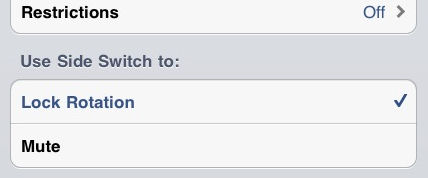
iOS 4.3 option will allow iPad's side switch to return to orientation lock functionality

With iOS 4.2, Apple turned the iPad's side switch from the orientation lock it had been since it released into a mute switch. Quite a few people were not happy with the change, and petitions were even started to change it back, or at least get an option. Well, for once Apple listened.

On Thursday, Apple released the iOS 4.3 beta SDK. As part of the changes to the software, Apple has added an option to set the iPad's side switch to either the mute switch Apple wanted or the orientation lock that users wanted.

It's true that the change Apple, made, requiring users to swipe the screen to the right and then select the screen orientation lock on the screen made the iPad consistent with the iPhone and iPod touch, but the iPad has less of a reason to have a quick way to mute than the other devices, especially the iPhone with its phone ringer.

Wednesday, 12 January 2011

Verizon Affirming The iPad Local 3G Network

Francis Shammo, chief financial officer of Verizon Communications Inc., confirmed what we already assumed: Verizon will soon have an iPad that can connect to its network without use of additional hardware. Currently, Verizon sells the iPad, but 3G connectivity for those who want it comes via a MiFi hotspot, which can provide connectivity for up to five devices.

Simply stated, there will soon be a CDMA version of the iPad. Whether that comes in the form of an iPad 2, which was already reported to be coming in three versions (CDMA, GSM, and wi-fi only), or sooner than that, is unclear.

Since October, Verizon has been selling the iPad, along with its MiFi mobile hotspot device for $629.99 to $829.99. That pricing is the same as the 3G-connected version, which can connect directly to AT&T’s network.

It's been expected for some time that with a Verizon iPhone would also come a Verizon iPad. Unlike the iPhone, there won't be any shortcomings vs. the AT&T network with regards to simultaneous voice / data support, as the iPad is not a phone.

Apple usually runs its devices on an annual refresh cycle; since the iPad is due for a refresh in April, the odds are that Apple will wait until then to introduce CDMA support with an iPad 2. Of course, that's all speculation, at this point.

Thursday, 6 January 2011

A new product signal? Apple restricting retail employees' vacations, starting at the end of January

We've seen this in past years, when Apple and / or AT&T have restricted vacations around a date that turned out later to be a high-profile launch. Now AppleInsider has learned that Apple is restricting vacation time for some of their retail employees beginning later this month.

The blackout period extends for some three weeks, beginning in the last week of January and extending through the first half of February. Those with seniority are unaffected, but other retail employees will be prohibited from taking any vacation.

In addition, Apple has retained the temporary retail staff that it and others usual eliminate from retail operations after the holiday shopping season ends.

The obvious reason is a product introduction, and the obvious product that would be introduced would be the Verizon iPhone. While there's also a chance this could be the iPad 2, that's less likely, based on all the signals that both AT&T, Apple and Verizon have been given over the last few months.

On the other hand, it's possible Apple is planning more than one introduction. As noted, the Verizon iPhone top of most lists as the most likely product, but while Apple tends toward annual updates of products, the iPad has been rumored to be getting an early update, to combat the wave of Android tablets being introduced at CES. In addition, with the recent unveiling of Intel's Sandy Bridge processors, another likely update could be Apple's Mac line.

At any rate, it appears that since this falls at the end of January, some folks might be getting Apple-centric Valentine's Day presents.

iPad 2 case appears at CES, complete with iPad 2 mockup

A number of iPad 2 cases have shown up on the Web, and all of them have been very consistent in the fact that they all have a camera hole in the back, a camera hole in the front, and a speaker hole. This Dexim keyboard is the same design, although it has an added feature: a Bluetooth keyboard that can adhere to one of the flaps.

Attach the keyboard, and it's sort of like a laptop. Remove the keyboard, and there's still something else in the case that different, a machined aluminum iPad 2 mockup inside. Aside from that, it's pretty similar to the cases that have leaked online, and that means it's pretty close to the rumored iPad 2. Of note is a home button that is positioned nearer the bottom edge, implying rumors of a slimmer bezel might be on target.

One more thing of note: all these similar iPad 2 cases must mean something, as all these manufacturers wouldn't be building cases along the same design unless they knew something. On the other hand, it's possible they're all wrong. Somehow that doesn't seem logical.

Engadget has a full gallery of shots.

Saturday, 1 January 2011

Twelve-year-old girl receives porn-laden 'PervPad' for Christmas

A 12-year-old Marion, Illinois girl received a lot more than she wished for from Santa, with a Android-based tablet she received containing two porn apps that had already been installed on the device. We can hear Apple CEO Steve Jobs repeating under his breath that "Android is for porn" already.

It's not the first time such an event has occurred, and it won't be the last, either, unless stores ensure they wipe returned smartphones and tablets before putting them back on the shelf.

That's the most likely way the apps got on the device, particularly since the parents bought two of them, one for their 12-year-old and the other for their 15-year-old daughter, and only the 12-year-old, who calls the device her PervPad, had the apps, which were "Boobs! Butts! Babes!" and"Undress Me."

There is quite a bit of technical naivete about what to do, and about the technology involved, in the story, however.
  • The local news crew (video report below) got a few things wrong, of course. They called the Coby Kyros "similar to the Apple iPad and Amazon Kindle." Oh, really?
  • The father called the manufacturer of the tablet, Coby, instead of simply going back to the store.
  • According to the father, Jay Hardin, the TS representative he spoke to told him that they have adult content in their application library as part of "each and every one of these things that they sell." There is no way any TS rep would have told Hardin that unless they were off their meds that day.
  • Meanwhile, Coby told the local news station, News 3, that there was no pre-programmed software installed by Coby (meaning the porn wasn't put there during production).
Meanwhile, Hardin is certain the original package seals were on the tablets. Even if the theory that the PervPad was pre-owned is true, that's still possible; many times retailers repackage items so well you can't tell the difference.

At any rate, Hardin said he is simply going to exchange the PervPad. There's been no squawking about a lawsuit, but if Hardin decides to go legal with this, it would probably be hard to prove that he didn't plant the apps himself. We aren't saying he did, mind you, but authorities are always very cautious about these types of reports, particularly after the Wendy's Chili / Finger incident.

You can watch the local news report below.


GoDaddy.com